Remembering Michele Massimo Tarantini
The passing of Michele Massimo Tarantini on Friday, April 3rd, took us all by surprise, precisely at a time when I was conversing with him about him visiting SITGES 2026. In an email he sent me several weeks ago from the Brazilian town of Saquarema, he told me: "Verrei con grande piacere in Spagna, paese che amo e deve praticamente ho iniziato la mia carreira cinematografica. Era aiuto regista e scenografo all' época degli spaghetti-western. In attesa di tue notizie. Ti mando un abbraccio”. ("It would be my great pleasure to visit Spain, a country I love and where I practically began my film career. I was an assistant director and set designer during the Spaghetti Western era. I look forward to hearing from you. Sending you a big hug.)
I was able to contact Michele Massimo Tarantini around 2009, all thanks to his cousin Sergio Martino. Although Michele had been living in Brazil since the 1980s and Sergio in Italy, they continued to maintain a very good relationship. So, I got in touch with him to talk about his work in the Italian film industry over the past few decades.
The interview you are about to read was originally published in El Buque Maldito #13 Fanzine in July 2010. And although Nudo e selvaggio (Massacre in Dinosaur Valley, 1985) takes up a significant portion of our conversation, I didn’t hesitate to use that opportunity to look back with him on a career that led him through many areas of filmmaking until he ultimately rose to become one of the kings of commedia sexy all’italiana, i.e. sex comedies Italian style, but who also ventured into cannibal movies and poliziesco, i.e. crime thrillers.
Rest in peace, Michele Massimo Tarantini.
You got your start in the film world in the 1960s, working as a production secretary alongside Antonio Margheriti.
My first job in cinema with Antonio Margheriti was also my first job in the film world, specifically on I giganti di Roma (Giants of Rome), a film from 1964, where I worked as a production secretary.
The following year would see the release of Luciano Martino’s film Le spie uccidono a Beirut (Secret Agent Fireball), if my memory serves me correctly.
Back then, I also worked as a screenwriter and executive producer of photo novels for the Bozzesi publishing house in Rome.
These feature films were followed by others, until I began working as a continuity coordinator for director Liliana Cavani.
And what was your relationship with Margheriti like?
My relationship with Margheriti was that of a student and his teacher. I mostly communicated with him through his assistant, Roberto Pariante, but I paid close attention to his masterful technique, especially his work with scale models. I learned a great deal during the shoots.
And let’s not forget your work with Liliana Cavani, whom you mentioned a moment ago, best known for her controversial film The Night Porter (1974).
Back then, I was fortunate enough to meet Leo Pescarolo, a producer at Clodio Cinematografica, who hired me as a continuity supervisor for Liliana Cavani on RAI's miniseries Francesco di Assisi, starring Lou Castel. And it was precisely with Clodio Cinematografica that I made several short films as a screenwriter and director, some of which won awards, such as I Pesciani and B su a 66.
Until the Luce Institute called me to work as a continuity coordinator on Ernesto Guida’s film Un amico (A Friend). It so happened that on the day we went to shoot on the island of Ponza, the assistant director dropped out; he had landed a permanent position as a director at RAI. So that’s when I began my career as an assistant director thanks to the film Un amico, taking on the dual role of editor and assistant director; and that wouldn’t be the last time I’d perform both roles on a film.
Leaving aside the 1960s—a very prolific decade!—at the beginning of the 1970s you became the editor for Brunello Rondi's giallo film Le tue mani sul mio corpo (1970).
I had worked with Brunello as an assistant director.
It so happened that at the start of post-production, they dismissed the original editor and offered me the job. I had already edited a few documentaries I’d made at Clodio Cinematografica. My work was given the green light, and from that point on, I began editing more films.
What was your period as a film editor like?
Editing was my most valuable experience. Every aspiring director should take a course in editing. During that period, I gained the technical confidence regarding the elements needed to convey a scene and, by extension, an entire film. Thanks to that work, I could, if necessary, make feature films in less time and more cost-effectively.
These were works that allowed me to gain a deep understanding of the mechanics and techniques of those genres that told —and continue to tell— the story of the eternal struggle between good and evil.
Starting in 1971, you began working as an assistant director on various gialli. First with Giuliano Carnimeo on The Case of the Bloody Iris (1972) and later with Sergio Martino on his masterpiece Torso (1973) and The Suspicious Death of a Minor (1975).
My relationship with Sergio Martino, aside from the professional one, is also a family one: his mother and my mother were sisters. We are cousins. And our grandfather, who was their father, was Gennaro Righelli. He was a very important film director in his day and made the first talkie in Italy: La canzone dell’amore around 1930. Getting back to Sergio Martino, I had already worked with him before Torso on the editing of two of his films, one of which was the 1970 western Arizona Colt, Hired Gun.
I will always be grateful to him for something he did for me. After I directed my first film in 1970, Sette ore di violenza per una soluzione imprevista (Seven Hours of Violence), which was an economic fiasco, he called me in a clear gesture of solidarity to offer me a position as an assistant director.
Without a doubt, a magnificent gesture by the great Sergio Martino!
Because we have such different personalities, Sergio had never wanted to work with me until then. I owe both Sergio and his brother Luciano Martino, producer at the legendary Dania Films, if not almost my entire professional career, then at least a large part of it.
I understand that you were also working in Spain during those years.
In order to embrace all aspects of filmmaking, I worked as a screenwriter, in costume design, and so on. And in Spain, specifically at Balcázar Studios, I worked as an art director on Joan Bosch’s film My Horse, My Gun, Your Widow.
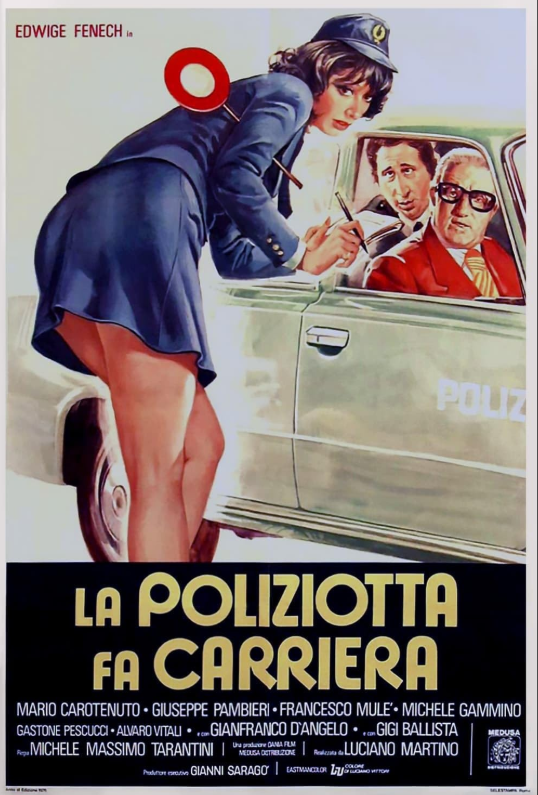
By the mid-1970s, you began your career more firmly as a director, becoming one of the kings of commedia sexy all'italiana thanks to films such as La poliziotta fa carriera (Confessions of a Lady Cop, 1976), starring Edwige Fenech and Alvaro Vitali, Taxi Girl (1977), in which both actors reprise their roles, or La poliziotta della squadra del buen costume (A Policewoman on the Porno Squad, 1979), where actor Lino Banfi joins Fenech and Vitali.
The opportunity to make all the films you just mentioned came thanks to The Teasers in 1975, starring Gloria Guida. It was a very low-budget film, but it was a box-office sensation and went on to become a cult classic in Italy. It was the second highest-grossing film in Italy that year and established me on the national film scene as a successful director and, today, as one of the kings of the commedia sexy all'italiana, since following The Teasers I directed countless films belonging to this genre with Edwige Fenech, Alvaro Vitali, Lino Banfi, Aldo Maccione, etc.
A period during which you didn't give up your work as a screenwriter.
As a screenwriter, I was already a “veteran” thanks to everything I’d been writing during those years for various colleagues who were already famous by then. However, I wasn’t able to use my own name, except on my documentaries and a TV movie, specifically for RAI. Later on, I was granted the “right” to use my name on my works, but during the period when I couldn’t, I at least had the privilege of learning the craft from genuine masters, a very important school of learning where, moreover, I was paid for something I would have done for free if that had been the case.
Why did you start using the pseudonym Michael E. Lennick to credit yourself on some of your films?
It was purely a business decision.
To increase the chances of selling an action movie overseas, it had to appear to be American, and through a phonetic twist on my name, Michele, Michael E. Lennick was born.
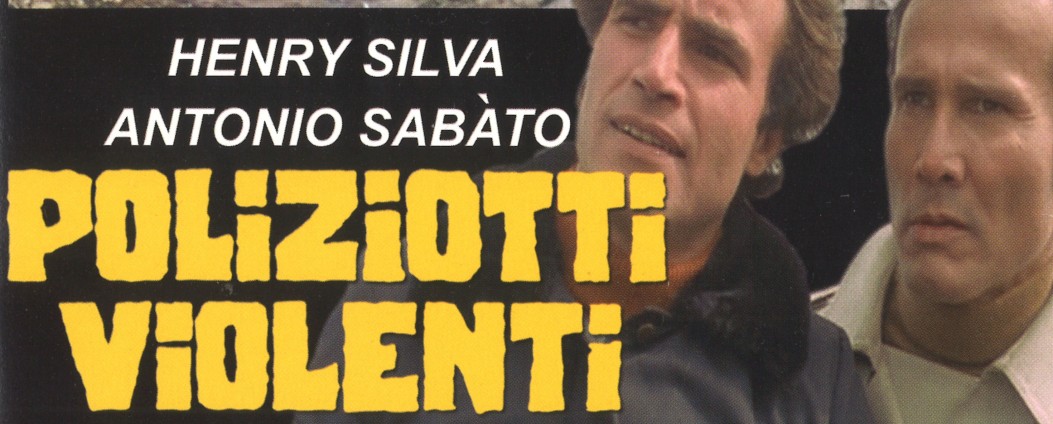
After venturing into the poliziesco crime thriller genre with Poliziotti violenti (Crimebusters, 1974) and A Man Called Magnum (1977), and a long list of commedia sexy films throughout the 1970s and early 1980s, 1985 saw the release of a cult classic in the cannibal movie genre: Nudo e selvaggio.
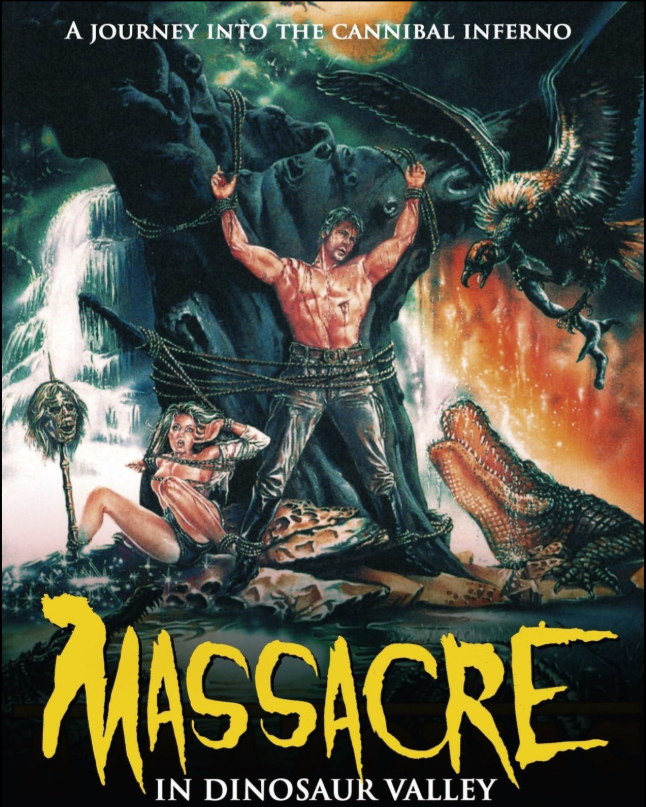
Nudo e Selvaggio (Massacre in Dinosaur Valley) was my second film produced and shot in Brazil. The first was Feras em fuga, known internationally under the title Women in Fury. In August 1983, I moved to Brazil, and in February 1984, I began shooting Feras em fuga.
How did Women in Fury (1984) go, your first adventure in Brazil?
I had to deal with major issues to be able to make Women in Fury, starting with the language, since I didn't speak a word of Portuguese.
The first two weeks, we had to film in São Paulo, at the infamous Carandiru Penitentiary, where a massacre of prisoners was committed by the police and which has since been converted into a cultural center.
On Saturday, I traveled to São Paulo with the entire technical and artistic crew, nearly fifty people. On Sunday evening, I found out that the local production company I had hired to organize the shoot in that area had pocketed the money without even bothering to obtain the necessary permits required for filming. I should mention that the company belonged to an Italian. Back in Rio de Janeiro, we managed to finish filming on schedule and without "busting" the budget.
How did Nudo e selvaggio come about?
The choice of a story generally depends on the international market, with the obvious exception of auteur films. And this was the case with Nudo e Selvaggio, for which we were able to secure exceptional locations in Brazil, where the entire film was shot. Although I should mention that the idea was actually conceived by Luciano Martino. While on a plane, he read that there's a valley in Brazil where you can clearly see dinosaur footprints. He commissioned me to make the film, I did the pre-production in Brazil, shot the film, and edited it.
As incredible as it may seem, it was filmed entirely in the city of Rio de Janeiro, in areas and parks that not even the locals from Rio themselves are familiar with.
While Rio de Janeiro’s nature is incredibly rich and lush, some of the credit also goes to my experience as an editor and screenwriter, which allows me to see, or more accurately, to envisage things that others can’t manage to bring to life.
Therefore, it’s an “urban” film set just a few steps away from virtually any restaurant. However, it wasn’t an easy film to shoot.
Having been filmed entirely in Brazil, I assume that the entire crew was local.
Since it was a Brazilian production, both the technical crew and the cast were local. The only exception was the leading man, American actor Michael Sopkiw, who was cast in the U.S. to help boost international sales. I should mention that I have dual citizenship, Italian and Brazilian.
What stands out in the story is its blend of genres, adventure, eroticism, cannibals, and the element of magic and the occult that surrounds the tribe which finds the travelers in the jungle. Why did you decide to include the story of the occult theme in the screenplay?
It’s a subject that has always captivated me, along with magic, whether real or imaginary, and it’s very common among the tribes of the Upper Xingu, where the story takes place.
Regarding this subject, I wrote an excellent script for the production company Number One, entitled Dark Love and set in Brazil and the U.S., but the production company, which at the time was considered one of the best in Italy, fell into crisis and the film couldn't be made.
Over the years, thanks to its various editions in different formats and countries, we’ve seen and read a number of titles: Perdidos no vale dos dinosaurios, Massacre in Dinosaur Valley, Cannibal Ferox 2, and so on.
The original title wasn't Nudo e selvaggio: it was Perdido no vale dos dinosauros.
Cannibal Ferox 2 was the brainchild of the co-producers following the success of Umberto Lenzi's film Cannibal Ferox.
And then in the '90s, and specifically in 1991, you worked on Umberto Lenzi's film Demoni 3 (Black Demons) as art director. How did that collaboration with Lenzi come about?
In 1991, Pino Gargiulo hired my production company to make two films in Brazil, both directed by Umberto Lenzi: Caccia allo scorpione d’oro (Hunt for the Golden Scorpion) and Demoni 3.
As everyone knew, and still knows, Lenzi isn’t exactly famous for his Tuscan charm, and during pre-production, problems arose between Lenzi and the producer. So, in order to stay “close” to Lenzi during filming, I was assigned the tasks of screenwriter and costume designer.
Why did you take a break from directing in the nineties?
During the first two years of the decade of the nineties, I served as executive producer in Brazil on a German film and an Italian film, the latter produced by Number One. Later, my wife was diagnosed with cancer, and after a seven-year battle, she passed away in May 1999. That year, Pino Gargiulo invited me to visit his production company in Italy.
As of the year 2000, you returned to writing and directing, this time for television. You even worked on the screenplay for Lamberto Bava’s film The Torturer (2005) alongside Luciano Martino, Dardano Sacchetti, and Lamberto himself.
My cousin Luciano Martino hired me to write four episodes of the TV series Turbo in collaboration with Dardano, and later came Lamberto Bava’s film The Torturer.
And to wrap up, do you have any projects planned for 2010?
I am currently translating L’ Angelo Custode into Portuguese. I wrote this work in Italy for producer Filiberto Bandini and actor Luca Laurenti, and Luca Biglione and Marco Lapi participated in the final script. But unfortunately, the film has never been made. It’s a sarcastic and irreverent comedy about love. And there’s a chance it might finally see the light of day with a Brazilian producer…
Anyone familiar with this country’s film, theater, and television industries knows that there are excellent and even outstanding actors who practice their profession with love, skill, and dedication. Of these, 99% have academic studies. Few are in it simply because they have a pretty face. It’s a genuine pleasure to work with them.
Previous content
Remembering José UlloaNext content
5 Out of More Than 100: TOP 5 Takashi Miike films