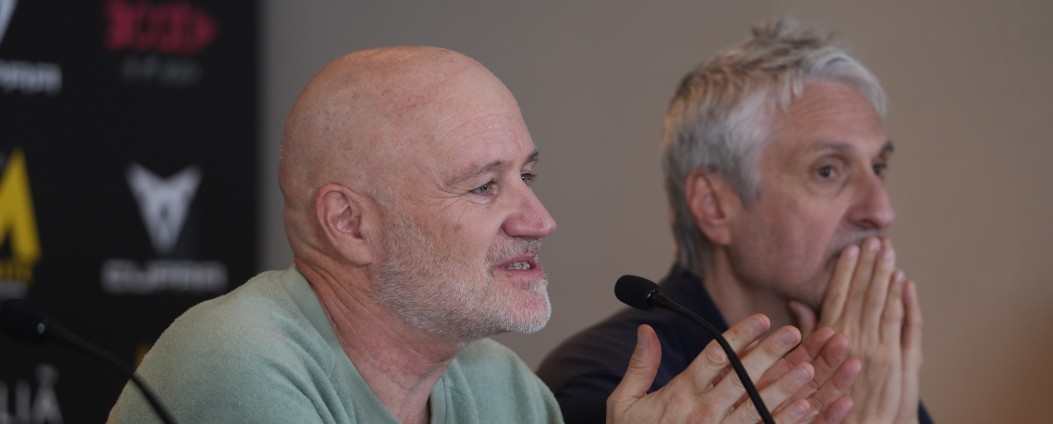
Interview with Jan Kounen
In 1956, Richard Matheson published The Shrinking Man, where Scott Carey accidentally ingests insecticide and is then exposed to a radioactive cloud. These two misfortunes trigger a fatal mutation that causes him to grow smaller and smaller every day. This existentialist science fiction novel was adapted for the big screen a year later by the author himself and directed by Jack Arnold. The Incredible Shrinking Man became a cult film, with Grant Williams taking on the family cat and a “giant” spider. Now, Jan Kounen presents The Shrinking Man (L'homme qui rétrécit), a new take on the original novel, both written and directed by him.
How did the project come about? Is it something personal or a commission?
The idea came from Jean Dujardin, who suggested making the film to Alain Goldman, the producer. It took them over a year to negotiate the rights to adapt it, and when they finally secured them, they contacted me to take on the task of writing the screenplay.
What's your relationship with the fantastic genre?
Despite having explored it at length in my short films, it's a genre I've always wanted to delve deeper into. I love science fiction and fantasy. Vibroboy, my first short film, belongs to the horror genre. I never thought I would do a genre piece like that, and then I was offered this film, which was a gift for me. In France, I don't have the power to go to a producer and say, “I want to do this.” But Jean does, and that's why it was wonderful.
Your career demonstrates that you are a director who is very interested in the visual aspect of your films, as seen in Dobermann and Renegade.
I think this is an essential part when it comes to conceiving a film. This film was a challenge, more than others, in terms of its visual effects, and our department being able to properly integrate to work in the way we wanted. It was a huge challenge, and we managed to raise quite a lot of money. Incidentally, although it was a big budget for France, it wasn't all that big for countries abroad.
What was the process of creating visual effects like?
Fairly complex, to be honest. It involved a method based on filming the actor with a free camera and accurately detecting his or her movements. The exact same camera movement was then reduced and repeated on a smaller scale, using a motion control system for the complementary shots. The major difficulty was combining these two parts. This technique, applied to four hundred takes, was extremely time-consuming: a single take could take up to ten additional weeks in the studio to complete. It was a risky and lengthy process, but it succeeded in achieving the desired atmosphere.
Taking into account that Jack Arnold's film is a classic, did you feel any extra pressure when it came to accepting the project?
It's important to make it clear that this isn't a remake, but another version of the original story. It's an adaptation of the book for today's audience. This has always been the case with works by Victor Hugo, for example. The subject of versions has always been a constant in the film world. Take the cases of Dracula or Frankenstein, for example, which have different versions. In this case, we are dealing with an important book in science fiction literature, although it's a book that's not as well known as it should be, despite being a classic. So, as a filmmaker, it's always valid to go back to the book, take elements from it, and put them in the film. Our intention is to honor the first adaptation and be able to reach new generations with it. We have respected the heroic journey, the essence of the book, and Jack Arnold's vision, so I am very happy with the final result.
What are your main genre influences?
I must confess that I don't really watch horror movies anymore. Real horror movies, the ones that are genuinely scary. When I was younger, I used to love them, but not so much anymore. I've always thought that the perfect horror movie was made in 1980 and that there will never be another one that can top it: The Shining. We could get into a debate about whether the fact that it's so good makes Stanley Kubrick the best horror movie director. Maybe so, but I'm not sure. Come to think of it, I realize that I love Joe Dante. When I was younger, I was a huge fan of his and of how his films blend comedy with darker humor and horror. Looking back, I really like how he has shaped his career. I had never thought about who my favorite horror director is, so thanks for that question. In the same vein, I could also say that the tone of Sam Raimi's films places him in this spectrum, so he could also be considered one of my main benchmarks. I'm fascinated by The Evil Dead and how feelings are intertwined in it: fear and laughter make a good combination. I think the trio of Kubrick, Dante, and Raimi is a good choice of names to highlight as the grand masters of genre.
By Javier Parra.
Previous content
Interview with Eugenia SampedroNext content
Interview with Laura Casabé